
|
Notice
The Association's involvement in the project to restore the Cass Scenic
Railroad State Park's Climax steam locomotive ended in December,
2015.
The new operator responsible for the Park's railroad operation and
maintenance, the Durbin and Greenbrier Valley Railroad, informed the
Association that its assistance in the project was no longer
need.
The Association began the massive restoration project in 2002 and it
was estimated to be approximately 80% complete. It is anticipated
that the remaining work on the locomotive will be completed by DGVR
personnel.
The home page on this site contains a statement by the President of the DGVR. We hope that he is correct and that the Climax Project is completed so this historic locomotive can be returned to active service. Although the Association is no longer involved in the Climax Project, this page is being kept as a partial (and very incomplete) record of what was done by Association volunteers. No additional work sessions will occur and donations for the project are not wanted. |
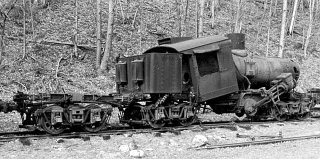 The
Climax locomotive sitting on the "dead
line" in Cass prior to the start of restoration work in 2002.
(Photo by Sonny Burruss)
|
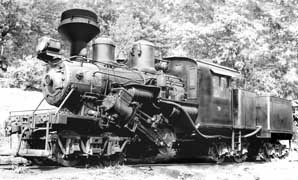 Artist's
rendition of how the Climax
locomotive will look after restoration is complete. (Image
by Richard Sparks) Artist's
rendition of how the Climax
locomotive will look after restoration is complete. (Image
by Richard Sparks) |
There
are several sources of funding for the Project.
As of December, 2012, the
Association and
individual donors have provided over $196,000 in funding to purchase
materials,
tools, and contracted services. The
State of West Virginia obtained a $200,000 Federal grant for the
project and
that money is being used to purchase several big-ticket items such as
axles,
new steel tires, gear castings, injectors, and air compressors. The Park already has
a
serviceable
replacement boiler on hand that will be used after some repairs and
certifications
are completed.
Also,
a number of
companies have provided services and materials free or at significant
discounts, and several have donated large machine tools to help equip
the
restoration facility.
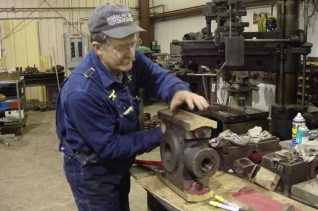 Restoration Project Leader Grady Smith assembling a repaired piston crosshead for the Climax locomotive. (Photo by Gerald Curtis) |
| January 18-19, 2014 |
Boiler work in the locomotive shop, making stairs for the cab |
| October 5-6, 2013 |
First filling of the new water tank; cab roof stiffeners; rail wetters |
| September 14-15, 2013 |
First run of the complete frame
(not a complete locomotive) |
| August 17-18, 2013 |
Installing the third truck. |
| August 3-4, 2013 |
Assembling and painting the
front (and final) truck. |
| July 13-14, 2013 |
#1 truck shaft gears installed;
safety chains and brake rod stirrup were put on; and machining on the
miter gear shaft was begun. |
| May 4-5, 2013 |
Work on the steam dome,
drawbars, joining the tender and main frame for the first time. |
| April 20-21, 2013 |
Building the steam dome shroud
and soldering two halves of a ring section together prior to machining.
|
| April 6-7, 2013 | Continued work on the brake rigging; applying the butt strap to the steam dome casing. |
| March 23-24, 2013 | Reaming brake hanger holes and brazing the worn ends of the front truck's bolster. |
| March 9-10, 2013 | Major work on the front truck, the new diamond stack, and both front and rear cut levers and grab rails. |
| February 23-24, 2013 | Inital assembly of front (final) truck, making a cut lever, swedging a bolt hole, making brake rod clevices |
| July 21-22, 2012 | Moving the 3rd truck into position under the tender frame |
| April 28-29, 2012 | Diamond stack construction; rear truck; shop overview photos |
| February 18-19, 2012 (2) | Moving the almost-completed water tank lid |
| February 18-19, 2012 | Center plate grooving; final water tank welding & lifting pads; stack height calculations |
| February 4-5, 2012 | Constructing the sand dome |
| January 14-15, 2012 (3) | Anatomy of a Shay smoke stack (compared to the Climax) |
| January 14-15, 2012 (2) | Stack ring machine work |
| January 14-15, 2012 | Placing the tender tank top |
| November 19-20, 2011 | Fabricating a center pin; Stack ring work;
Countershaft bracket truss rods; Water tank riser |
| April 30 - May 1, 2011 (3) | Manufacturing babbet hammers |
| April 30 - May 1, 2011 (2) | Tender truck gear assembly; Water tank welding; split washer & spacer machining |
| April 30 - May 1, 2011 | Installing tender truck gears & bolster; sand boxes; water tank bottom welding |
| April 16-17, 2011 | Gear shaft assembly; machining gear shaft; sandbox |
| April 9-10, 2011 | Truck assembly, ladder fabrication, water tank interior view |
| April 2-3, 2011 | Machining bearings |
| March 26-27, 2011 | Drilling front bolster and shaft machining |
| February 12-13, 2011 | Tank baffles & outlets; swivel plates; gear shafts |
| December 18, 2010 | (off site work session) Boring the Climax locomotive's pinion gears |
| November 20-21, 2010 | Tender tank; Climax ladder; center plates; misc. parts |
| November 13-14, 2010 | Cross box bearings; water tank trim; brake hanger holes |
| November 6, 2010 | Machining gear shaft bearings; miscellaneous activities. |
| October 9-10, 2010 | Various machining and welding activities; cleaning telltales on the boiler. |
| September 25-26, 2010 | Miscellaneous tasks (boiler, water tank trim, machining) |
| May 11, 2010 | Cross box boring |
| April 10-11, 2010 | Water tank baffle installation; Boiler thickness measurements |
| March 13-14, 2010 | "Before" locomotive photos; masking frame parts; machining work |
| February 20-21, 2010 | Truck assembly; thrust washer machining; grinding lapped cylinder seals |
| January 30-31, 2010 | Water tank fabrication and welding; Truck component bending |
| January 16-17, 2010 | Machining a bolster swivel plate; rebuilding an arch bar truck frame |
| November 21-22, 2009 | Wood work on tender tank decking; general machining |
| November 14-15, 2009 | Additional assembly of the tender truck; begin making water tank deck |
| November 7-8, 2009 | Initial (partial) assembly of the tender truck |
| October 31 - November 1, 2009 | Drill the new top bar for the truck frame; painting; bending bolster truss rods; brazing up a casting defect |
| October 2-4, 2009 | Sandblast and paint the frame and other parts |
| September 19-20, 2009 | prepare frame for sandblasting; move tender truck |
| February 2-3, 2008 | Coal bunker; lathe rebuilding; bolster swivel plates; water tank, shop views |
| January 19-20, 2008 | Coal bunker; pinion shaft removal; rear coupler pocket |
| January 5-6, 2008 | Frame repairs; horn/pinion gear work; center (swivel) plates |
| March 31 - April 1, 2007 | Horn machining |
| March 17-18, 2007 | Drawbar pocket; square shafts; horn welding; storage locker; main frame |
| March 3-4, 2007 | Square shafts; coal bunker; drawbar pocket; radial-arm saw |
| February 17-18, 2007 | Horn castings; Reed Prentice lathe, draw-bar pins; square shafts |
| January 20-21, 2007 | Crankshaft machining; tank frame work; main frame; square drive shafts |
| January 6-7, 2007 | Transport donated machine tools; delivery of repaired smoke box saddle; crankshaft machining |